One room that never gets comfortable
A leak or disconnect in that room's run is the usual cause. The run is traced and the fault fixed, instead of turning the thermostat up for the whole house.
Duct trouble in a Denver home usually announces itself as a symptom: a bedroom that never warms up, weak air at a register, or a system that runs all day without catching up. The cause often sits in the ducts themselves, a leak, a disconnect, or a crushed run. Call (720) 806-7634 and describe what is noticed room by room.
Call (720) 806-7634 and name the rooms that never feel right. Lion Tech Home Services talks through duct symptoms and books an inspection.
Call Now (720) 806-7634 → Open 24 hours · 7 days a week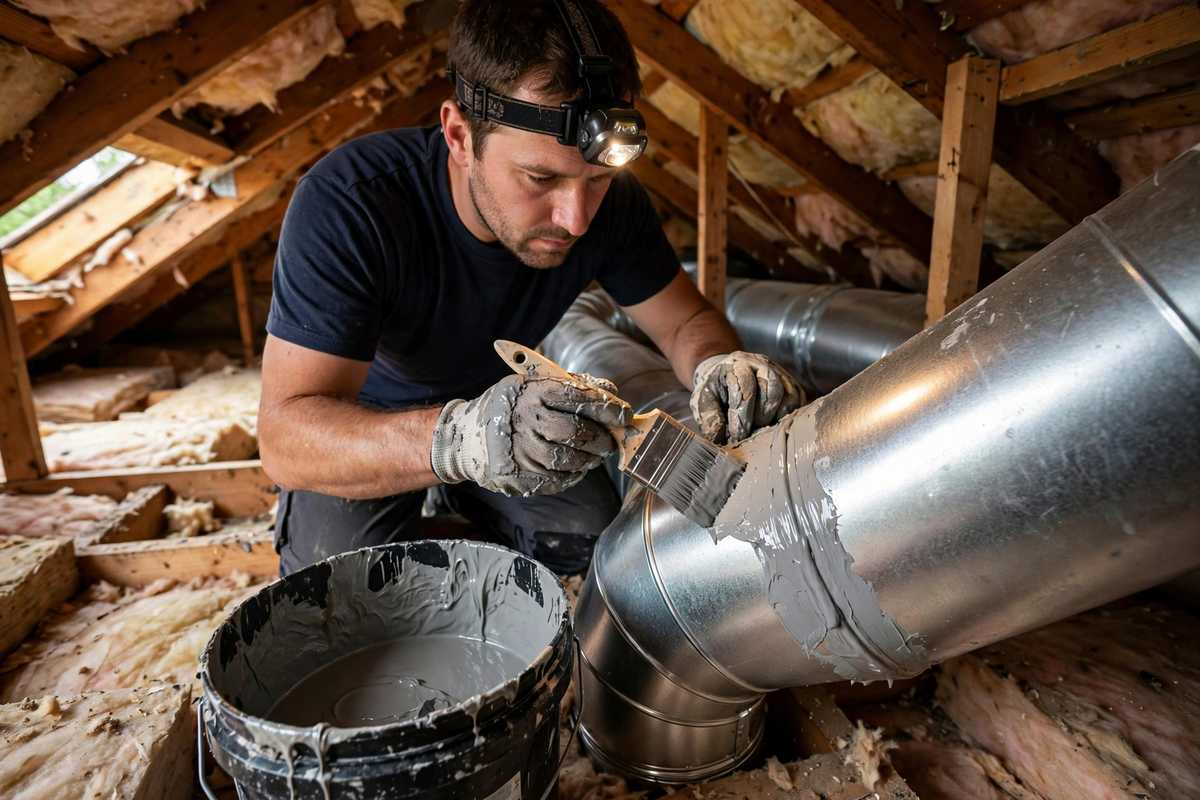
Duct repair means finding the faults in the ductwork that carries air through a home: joints that have opened, sections that have come apart, flexible runs crushed or kinked, insulation fallen away, and then fixing them so air reaches the rooms again.
Older Denver homes hold ductwork added to, moved, or left alone for decades. Joints open, flexible duct sags and crushes, and runs in attics and crawl spaces take the worst of it. A repair visit starts with inspection: the accessible runs are looked through, airflow is tested, and what is found is shown before anything is fixed.
Inspection comes before the fix, so the repair lands on the real fault.
Accessible supply and return runs are looked through for leaks, disconnects, crushed sections, and insulation that has fallen away.
Air at the registers is measured, showing which runs are starved, so the repair targets the actual problem.
Leaking joints and seams are sealed with mastic, which holds where tape peels and fails.
Sections that have come apart are refitted and sealed, sending air to the room instead of into the attic or crawl space.
Crushed or torn flexible duct and damaged rigid sections are replaced with runs sized for the job.
Airflow is measured again after the fix, confirming the rooms receive the air they need.
Name the rooms affected and the symptoms: weak air, hot and cold rooms, dust, or noise from the ducts.
The accessible ductwork is checked for leaks and damage, and airflow is measured at the registers.
The faults and the repair are explained, so the problem is seen before it is fixed.
Runs are reconnected, sealed, or replaced, and insulation is put right where it has failed.
Airflow is measured again and the rooms are checked, so the fix is confirmed rather than assumed.
Inspection and testing instruments that locate duct faults instead of guessing at them.
Looks inside runs to find disconnections, crushed sections, and blockages without opening walls.
Reads air at each register before and after the repair, so the improvement is measured.
Shows whether the ducts are choking the system and where the restriction sits.
Seals joints for the long term, where tape alone would peel and leak again.
Makes small leaks at joints visible so none are missed.
Cuts and fits replacement sections to the size the run needs.
One bedroom barely received any air. Its run had come apart in the attic, so most of its air was heating the attic instead of the room.
The run was reconnected and sealed, and the bedroom now receives its full share of air.
A flexible run had been crushed where it crossed a joist, cutting airflow to two rooms to a trickle.
The crushed section was replaced with a properly supported run, and both rooms now hold temperature.
An older duct system leaked at joint after joint, pulling dusty attic air into the supply and wasting heated and cooled air.
The joints were sealed with mastic and the system retested. Airflow at the registers rose and dust at the vents dropped.
Duct faults appear as comfort problems first. These are the ones found most often in Denver homes.
Ask a pro →A leak or disconnect in that room's run is the usual cause. The run is traced and the fault fixed, instead of turning the thermostat up for the whole house.
Crushed runs, leaks, and closed dampers all cut airflow. Measuring air at each register shows where the loss sits.
Leaky return ducts pull dusty air from attics and crawl spaces. Sealing the leaks keeps that air out of the system.
When ducts lose air, the system runs longer to hold temperature. Fixing the ducts takes that extra running time off the equipment.
Lion Tech Home Services traces and repairs ductwork in Denver homes from 7575 E 29th Pl #4052.
Eleven Google reviews put Lion Tech Home Services at 5.0 stars.
“Martin was great! Timely, knowledgeable, and his experience showed. He was able to fix our HVAC that had been having trouble on and off for awhile. Pricing was good and reasonable! Would certainly recommend!”
JulieGoogle review
✓ VerifiedHot and cold rooms, weak airflow at a register, dust around vents, rattling or whistling from the ducts, and a system that runs longer than it used to. Any of these is worth an inspection.
Yes. Leaks at joints and disconnects let conditioned air escape into attics and crawl spaces, and let unconditioned air in. Sealing the leaks is often the most effective comfort fix in an older Denver home.
The accessible runs are inspected, a camera is used inside the ducts, and airflow is measured at the registers. A smoke pencil makes small leaks at joints visible. Together they find faults a look from outside would miss.
It depends on the condition of the runs. Isolated leaks, disconnects, and crushed sections are usually worth repairing. Ductwork failing throughout the house may be better replaced. What is found is shown and both options are talked through.
Call (720) 806-7634 and describe the rooms that are not comfortable. Lion Tech Home Services will inspect the ductwork and show what is found.
Call (720) 806-7634 →Lion Tech Home Services, Denver — call (720) 806-7634, open 24 hours.