Warm air from the vents
Warm air usually traces to charge, airflow, or a compressor not running. Refrigerant pressures are read, indoor coil, filter and blower checked.
Central air conditioning is one system, not three separate jobs: the condenser outside, the coil and blower inside, and the ductwork that carries the cool air. When one part of that chain is wrong, the whole house feels it.
Any hour of the day or night, the phone is answered. Ring (720) 806-7634, say what the system is doing, and the whole chain gets talked through.
Call Now (720) 806-7634 →Phone-only booking — ring and the visit is arranged.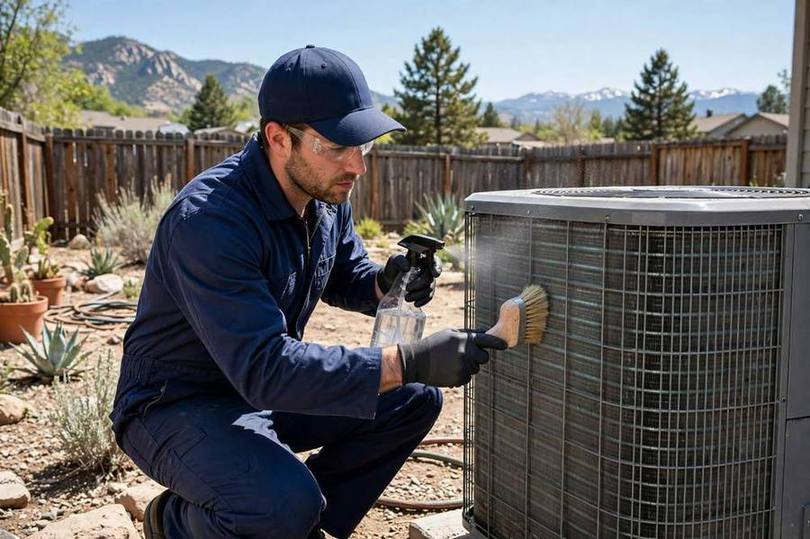
Central air conditioning covers the whole cooling chain: outdoor condenser, indoor evaporator coil, blower and air handler, refrigerant lines, thermostat, and the ductwork moving cooled air to every room. Repair, replacement and ductwork are handled as one system, not separate jobs.
Altitude and sun shape Denver's cooling load. Summer highs reach the 90s most years, and air at 5,280 feet cuts capacity by roughly a tenth to a seventh. Many homes in Denver's older neighbourhoods carry ductwork built for heating first, so the ducts are inspected as part of the chain, not as an afterthought.
A central system is only as strong as its weakest link. Here is what gets looked at across the whole chain.
Outdoor unit inspected and cleaned, fan motor, capacitor and contactor tested, refrigerant pressures read. Dust-clogged fins are a Denver regular.
Evaporator coil inspected for freezing and dirt, blower wheel checked, filter changed when loaded. A frozen coil is usually an airflow problem, not a coil problem.
Pressures and superheat are set against the maker's figures. Low charge means a leak somewhere, and the leak is found rather than topped up and forgotten.
Supply and return runs are inspected for leaks, crushed sections and disconnected joints, above all in attics and crawlspaces where Denver's temperature swings work joints loose.
Thermostat checked against the actual room temperature, and control wiring and safety switches tested so the system answers a call for cooling.
Airflow is measured at the registers so hot rooms are traced to their cause — a duct run, a damper, or a system never sized for the house.
Ring (720) 806-7634 and describe what the system is doing — warm air, uneven rooms, a noise, water where it should not be — and the house itself. Symptoms point to where the fault lives.
Pressures and temperatures are read at the condenser, indoor coil and blower checked, airflow measured at the registers, so the system is seen as a whole.
Before any work begins, you hear what is wrong and what the fix involves. When the problem sits in the ductwork rather than the unit, that comes out too.
Once agreed, the failed part is replaced, the system replaced where that fits better, or the ductwork repaired — then the system is tested through a full cooling cycle.
What was done is shown to you, the filter changed if it was clogged, and the thermostat set together. Later questions go to the same number.
Every part of the chain needs a reading. These are the instruments that take them.
At the condenser, refrigerant pressures are read so charge can be set against the maker's numbers instead of guessed.
Capacitor, contactor, fan motor and control board get meter tests. Electrical faults cause most summer failures, and a meter finds them.
The drop is measured at the coil and again at the registers, room by room, as proof the cooling reaches everywhere evenly.
It finds refrigerant leaks at joints, coils and valves, and checks duct joints for air leaks that waste cooled air into the attic.
Airflow through the ductwork is measured, so restricted or leaking runs are found instead of guessed at.
Bent condenser fins get straightened so air moves through the outdoor coil as designed. Denver dust and storms fold fins faster than most climates.
A two-storey home in Denver cools the ground floor well, but upstairs bedrooms stay warm all summer even with the thermostat turned down.
Airflow is measured at the registers and duct runs inspected. A duct problem — not the AC unit — is the usual cause of a hot upstairs.
In Park Hill, a central AC runs all afternoon while the house stays warm, and air from the vents feels only faintly cool.
At both units, pressures and temperatures are taken, and the filter and coil are looked at. A charge running low or a clogged filter are the usual causes.
In Denver, a central AC from the early 2000s has cooling bills creeping up and two rooms that never cool properly.
Unit, coil and ductwork are looked at together, and the conversation covers whether repair, replacement or ductwork is the right next step for that house.
Central cooling trouble mostly follows a few familiar patterns. These are the ones seen most across Denver, and the way each is approached.
Ask a pro →Warm air usually traces to charge, airflow, or a compressor not running. Refrigerant pressures are read, indoor coil, filter and blower checked.
A hot upstairs and a cold downstairs usually mean ductwork or airflow, not the AC itself. Airflow is measured at the registers and duct runs inspected.
A frozen coil points to restricted airflow or low refrigerant. Filter and blower are looked at first, then charge is read and a leak hunted.
Water near the air handler usually means a blocked condensate drain or a frozen coil thawing. Drain line and coil are checked before anything else.
Much of Denver's ductwork was built for heating first, in homes whose median build year is 1975, so a central AC visit here always includes the ducts — a cooling system cannot out-perform the runs that carry its air.
Google shows 11 reviews for Lion Tech Home Services, all five stars, and a 5.0-star rating.
“Absolutely excellent service - very responsive and able to work until the job is done right. Was super impressed by the support on our fireplaces and furnace - nice to have all up and working again! Many thanks”
John-Erik Emmetsberger — Google review
Central AC cools the whole house through ductwork from one outdoor unit and one indoor coil. A ductless mini-split cools individual rooms with wall-mounted heads and no ducts. Homes without ductwork usually suit a mini-split; homes with good ducts usually suit central air.
Cool air is heavy, so it settles downstairs, and duct runs to the upstairs are often the longest and leakiest in the house. Airflow is measured at the registers and duct runs inspected to find where cool air is being lost.
It turns on whether the job is a repair, a replacement, or ductwork — and on the size the home needs and the state of the ducts. The diagnostic comes first; you hear what the work involves before anything is booked. Ring (720) 806-7634 to talk it through.
Lion Tech Home Services looks after central air conditioning across Denver, from Park Hill and Hilltop to Washington Park and Central Park. Ring (720) 806-7634 — the phone is answered around the clock.
Ring (720) 806-7634 and describe what the system is doing. The whole chain — condenser, coil, blower, ducts — is looked at, and the next step talked through.
Call (720) 806-7634 →Lion Tech Home Services, Denver — call (720) 806-7634, open 24 hours.