A flame sensor going weak
A flame sensor coated in carbon shuts the furnace down without warning. Cleaning and testing it in the fall removes the most common no-heat cause Lion Tech Home Services sees.
A furnace that has not been looked at since last winter is the one that quits on the coldest night. Furnace maintenance is a seasonal check of the burners, ignition, airflow and safety controls — the parts that fail when the heating load is heaviest.
The phone is answered any hour, day or night. Ring (720) 806-7634, say what furnace you have and when it was last opened, and the visit goes in the diary.
Call Now (720) 806-7634 →Phone-only booking — ring and the visit is arranged.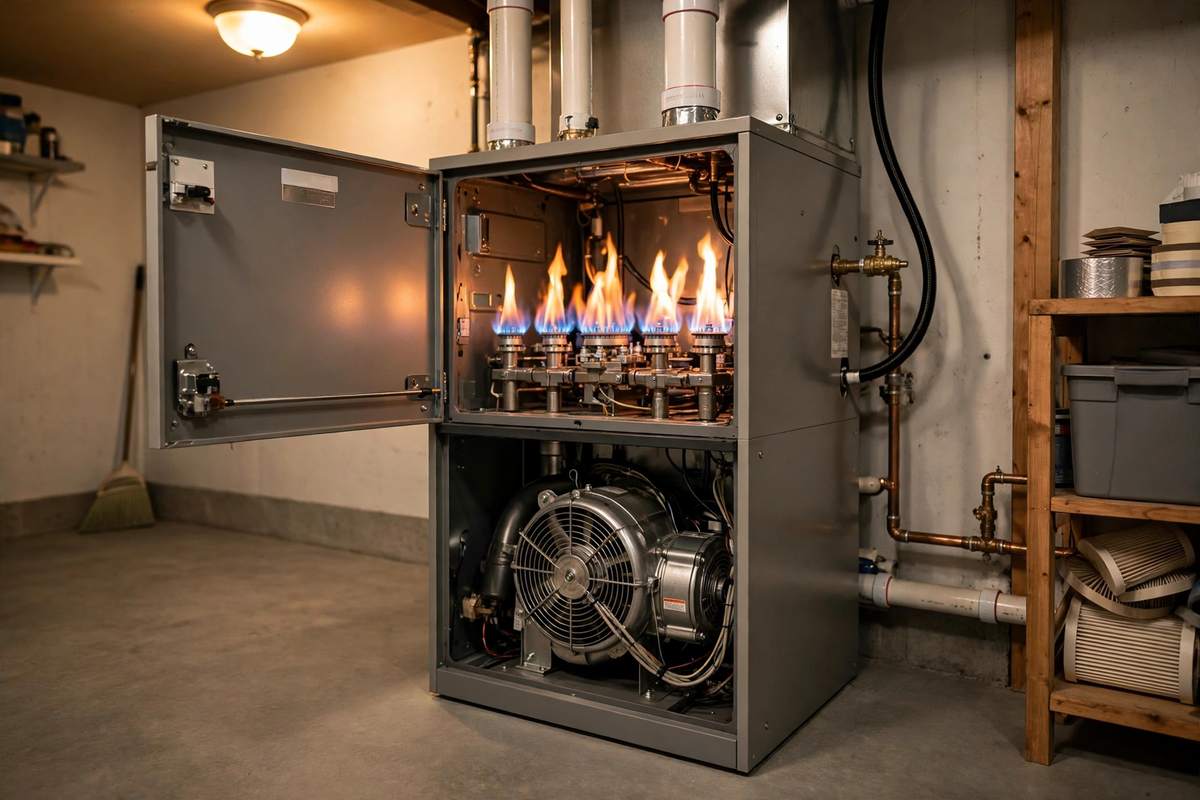
Maintenance is a planned visit, not a breakdown call. Burners inspected and cleaned, ignition system and flame sensor tested, blower and filter checked, furnace run through a heat cycle — to confirm it is ready for the heating season.
Denver's heating season runs long, around 6,000 heating degree days a year, so a furnace here works harder than one in a mild climate. Dry air and wide day-to-night swings wear on igniters and heat exchangers, and a fall check catches that wear while there is still time to fix it. Older forced-air systems in Denver's mid-century neighbourhoods gain most.
The visit follows a checklist, in order, with a reading taken at each step, so worn parts are spotted before they fail.
Burners inspected for rust, sooting and uneven flame, then cleaned so the furnace lights evenly across the burner rack. Delayed ignition starts here.
Igniter and flame sensor tested and cleaned. These two parts cause a large share of no-heat calls, and both give warning signs a maintenance visit can catch.
Blower wheel inspected for dust build-up, filter checked and changed when loaded, airflow measured. A clean blower moves heat the way the furnace was built to.
Limit switch, pressure switch and rollout controls tested to confirm they trip when they should. Safety controls that never trip are worse than none at all.
Carbon monoxide measured at the supply plenum, heat exchanger and flue inspected. A maintenance visit is the right time to catch a developing exchanger problem.
The furnace runs a complete heat cycle with temperature rise checked against the maker's range, so a steady cycle is known before winter.
Ring (720) 806-7634, describe the furnace — its age, its last check, anything you have noticed. The visit is arranged and the check talked over.
The furnace is opened, burners and heat exchanger inspected, ignition system, flame sensor and safety controls tested.
Burners are cleaned, blower inspected, filter changed when loaded. A dirty filter is the most common cause of short-cycling Lion Tech Home Services sees.
A full heat cycle runs while temperature rise and carbon monoxide are taken, and airflow is measured at the registers.
Findings are explained in plain words, and the worn part is shown to you where there is one.
These are the readings that show whether a furnace is ready for winter.
Carbon monoxide, oxygen and flue temperature are measured to confirm clean burning and correct venting once the burners have been cleaned.
It tests igniter, flame sensor and blower motor for wear. A flame sensor reading drifting down is a breakdown waiting for January.
It checks gas pressure at the valve so the furnace fires at its rated input through the season, not just on the day of the visit.
They measure airflow before and after the filter and blower are cleaned, so restricted airflow is found rather than guessed at.
Inside the heat exchanger, a borescope looks for cracks and corrosion the eye cannot reach from the access panel.
They check temperature rise across the furnace against the maker's range — the simplest proof the system heats as built.
In Denver, a furnace has never been opened since installation. It still heats, but the flame looks uneven and the filter is grey.
Burners cleaned, igniter and flame sensor tested, filter changed, full heat cycle run with carbon monoxide checked.
A furnace in Denver started switching on and off every few minutes late last winter, and the pattern came back with the first cold snap.
Filter, blower wheel and static pressure are checked first, then the limit switch is tested. Airflow restrictions are the usual cause.
A family that moved to Denver recently has a furnace nobody has ever serviced, with no record of its age. They want to know its condition before winter.
The full check is worked through — burners, ignition, safety controls, airflow, carbon monoxide — and findings come back in plain words.
Winter breakdowns usually give warning in the fall. A maintenance visit is designed to catch those warnings.
Ask a pro →A flame sensor coated in carbon shuts the furnace down without warning. Cleaning and testing it in the fall removes the most common no-heat cause Lion Tech Home Services sees.
A loaded filter makes the furnace overheat and trip its limit switch. The fix is a filter change and a blower check — both belong to the visit.
Rust and soot on the burners cause delayed ignition and rumbling. Cleaning the burner rack in the fall keeps lighting even through the season.
A limit switch or pressure switch that has stopped working never protects the furnace when it overheats. Testing them belongs to every maintenance visit.
Denver's dry air and wide day-to-night swings wear on igniters and heat exchangers through a heating season of around 6,000 degree days — a fall check catches that wear while there is still time to fix it.
Lion Tech Home Services is 5.0 stars on Google, with 11 reviews behind the rating — every one five stars.
“Absolutely excellent service - very responsive and able to work until the job is done right. Was super impressed by the support on our fireplaces and furnace - nice to have all up and working again! Many thanks”
John-Erik Emmetsberger — Google review
Autumn, before the heating season starts. September to November is the usual window — Denver heats for a long season, so the check belongs before the furnace carries its heaviest load.
Burners inspected and cleaned, igniter and flame sensor tested, blower and filter checked, safety controls tested, carbon monoxide measured, full heat cycle run.
A furnace can heat perfectly well while a part wears out. A flame sensor going weak or a filter choking airflow gives no warning until it fails, and the visit finds those parts before they turn into a no-heat call.
Hold it up to the light: if light no longer passes through, it is loaded. A clogged filter is the most common cause of short-cycling Lion Tech Home Services sees, and it is changed on the visit when needed.
Ring (720) 806-7634 to book a furnace maintenance visit. The check runs in order, and the findings come back in plain words.
Call (720) 806-7634 →Lion Tech Home Services, Denver — call (720) 806-7634, open 24 hours.