AC blowing warm air
Warm air usually comes from charge, airflow, or a compressor not running. Pressures are read, and the indoor coil, filter and blower are checked.
An air conditioner that quits in a Denver July leaves a house hot within hours, and the dry heat makes it worse. AC repair starts with finding the cause — refrigerant, capacitor, frozen coil, control fault or airflow — and fixing what actually failed.
The phone is answered at any hour. Call (720) 806-7634 and say what the system is doing — the fault is talked over from the symptoms.
Call Now (720) 806-7634 →Phone-only booking — ring and describe the fault.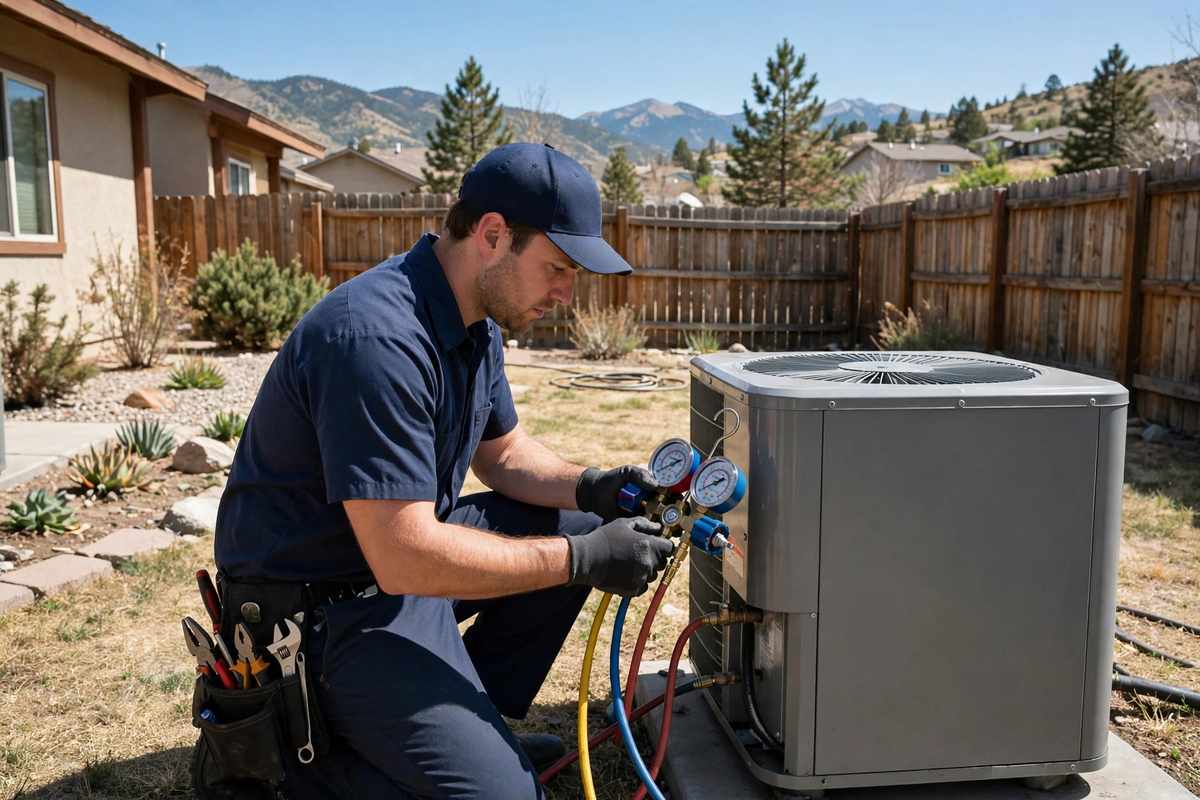
A repair visit is diagnosis first, then the mechanical work that restores cooling: warm air, no start, freezing up, one room cool and the next warm. The visit starts at both ends — indoor coil and blower, outdoor condenser — because a fault found at one end often starts at the other.
Summers in Denver run into the 90s most years, and the thin air up here takes roughly a tenth to a seventh off a system's capacity, so a unit here works harder than the same one at sea level. Dry-climate dust clogs condenser fins fast, and many homes in Cherry Creek, Hilltop and Washington Park cool through ductwork that was built for heating first.
Measure first, find the fault, explain it, fix what failed, then test a full cycle. Every visit follows that shape.
Pressures and temperatures are read, indoor coil and blower checked, outdoor condenser tested. A fault found at one end often starts at the other.
Capacitor, contactor, fan motor and control board are meter-tested. Capacitors fail most in summer, and a weak one shows on a meter before it quits.
A frozen evaporator coil is usually an airflow or refrigerant problem, not a coil problem. Filter, blower and charge are checked before anything thaws.
Superheat and pressures are set against the maker's numbers. A charge that has slipped means a leak somewhere — topping up without finding it only postpones the next call.
Filter, blower wheel and duct connections are checked. Restricted airflow freezes coils and makes a healthy system look broken.
After the fix, a full cooling cycle runs and the drop across the coil is checked, so the system is known to cool as built.
Ring (720) 806-7634 and describe what the AC is doing — warm air, no start, freezing up, a new noise, water where it should not be. Symptoms point to where the fault lives.
At the condenser, pressures and temperatures are read, the indoor coil and blower are checked, and capacitor, contactor and controls get meter tests.
No work starts until the fault, its cause, and what the repair involves have all been heard. A frozen coil comes with the reason it froze, not just the fact that it did.
Once you agree, the failed part is swapped or the leak traced and repaired, and a full cooling cycle is run.
You are shown what failed, the filter is swapped if it was clogged, and the thermostat is set with you. Questions later go to the same number.
Cooling diagnosis is reading work. These instruments separate a guess from a fault.
Refrigerant pressures at the condenser are read so the charge is set to the maker's numbers instead of guessed.
It tests capacitor, contactor, fan motor and control board. A weak capacitor is replaced before it strands the system in a heat wave.
They measure the drop across the indoor coil — the simplest proof the system cools as built.
Joints, coils and valves are swept for refrigerant leaks. A charge running low always has a cause, and the detector is what finds it.
Bent condenser fins are straightened so air can move through the outdoor coil the way it was designed. Denver dust and hail fold fins faster than most climates.
They measure airflow through the system. A frozen coil is often an airflow problem wearing a refrigerant disguise.
In Cherry Creek, an AC runs all afternoon and the house stays warm, the air from the vents only faintly cool.
At the condenser, pressures and temperatures are taken, and the indoor coil and filter are looked at. A low charge or a clogged filter is usually the cause.
A condenser in Denver hums when the thermostat calls for cooling, but the fan never spins and the house keeps warming.
Capacitor and contactor are tested first. A failed capacitor is the most common cause, and it shows clearly on a meter.
In Denver, ice is forming on the indoor coil and water is dripping where it should not be.
Filter and blower are checked for airflow restrictions and the charge is read. A frozen coil is a symptom, and its cause is found before it thaws.
No-cool calls mostly follow a few familiar patterns. The ones seen most across Denver are these, and how each is approached.
Ask a pro →Warm air usually comes from charge, airflow, or a compressor not running. Pressures are read, and the indoor coil, filter and blower are checked.
No start is usually electrical. Capacitor, contactor and control board are tested, and power is checked at the disconnect and breaker — a meter finds these.
A frozen coil usually means restricted airflow or low refrigerant. The filter and blower get looked at first; then the charge is read and the leak is hunted.
Uneven cooling usually means ductwork or airflow, not the AC itself. Duct connections are checked and airflow measured at the registers.
At 5,280 feet the air is thinner and a central AC loses roughly 10–15% of its sea-level capacity, so a Denver repair visit starts with readings — a system here has little margin for a fault left half-diagnosed.
A 5.0-star rating on Google, built from 11 five-star reviews, is what Lion Tech Home Services carries.
“Martin does great work, is very transparent about costs, and most importantly backs up his work and will double back if needed without a question. I'll absolutely be using Lion Tech again when I need help around my homes.”
Dominic East — Google review
Low refrigerant charge, clogged filter, frozen coil, or failed capacitor are the usual causes. Pressures and temperatures are read at both units to find which one it is, rather than guessing at parts.
Switch cooling off, let the coil thaw, and look at the filter — a clogged filter is a common cause. Do not keep running it frozen. Ring (720) 806-7634 and Lion Tech Home Services will find why it froze.
It depends on the failed part. A capacitor job and a compressor job are very different, so diagnosis comes first, and the fault and the repair are explained before any work starts.
Lion Tech Home Services fixes central air conditioning across Denver, from Cherry Creek and Hilltop through Washington Park to Central Park. Ring (720) 806-7634 — answered around the clock.
Call (720) 806-7634 and say what the system is doing; the visit is talked over on the call, including the first thing to check.
Call (720) 806-7634 →Lion Tech Home Services, Denver — call (720) 806-7634, open 24 hours.