Furnaces, boilers and the controls between them

Heating system repair Denver, furnace or boiler

Heating system repair covers more than the box in the basement — it is the furnace or boiler, the thermostat, the ducts or radiators, and the controls that tie them together. When the heat stops, the fault can sit anywhere in that chain.

↗
Call any time

Call (720) 806-7634

Any hour of the day or night, the phone is answered. Ring (720) 806-7634, say what heats the house and what it is doing, and the visit gets talked through.

Call Now (720) 806-7634 →Phone-only booking — name the system and the fault.
Heating System Repair Denver — Lion Tech Home Services
The whole heating chain, checked as one system.
About this service

Heating system repair in Denver: what the visit covers

Heating repair covers the whole chain keeping a Denver home warm: gas furnaces and boilers, thermostats and controls calling for heat, ductwork or radiators carrying it to the rooms. A visit starts with symptoms and system type, because a furnace home and a boiler home are diagnosed down different chains.

Denver heats with a mix of systems. Gas furnaces with central air fill most mid-century homes, boilers with radiators warm the pre-war stock of Capitol Hill, Park Hill and Washington Park, and cold-climate heat pumps are growing in newer homes. Around 6,000 heating degree days a year makes heating the year-round core here, and no-heat in winter is the emergency trigger.

  • ✓Furnace, boiler and controls checked together
  • ✓Thermostat, ducts and radiators included
  • ✓Gas smell and carbon monoxide taken seriously
  • ✓Heat tested room by room after the fix
What's included

What a heating system repair visit includes

A heating call is worked through as one chain — heat source, controls, and the ducts or radiators carrying the heat — and the fault is found, explained in plain words, fixed where it failed, and proven with a room-by-room heat test before anyone leaves.

✓

System identified first

The first job is naming the system: a gas furnace pushing air, a boiler moving water through radiators, a heat pump doing both jobs, or a house where two of those meet. The diagnosis follows whichever chain that house actually has.

✓

Heat source diagnostic

At the unit, the heat source gets its own checks — burner and ignition on a furnace, burner and circulator on a boiler, reversing valve and defrost on a heat pump — because a unit that will not fire, one that fires without heating, and one that heats only half the house are three different faults.

✓

Thermostat and controls tested

The call for heat is traced from the wall to the unit: thermostat against a separate thermometer, wiring and zone valves, then the safety controls that can shut a healthy system down. A thermostat reading a few degrees wrong makes a sound furnace or boiler behave like a broken one.

✓

Distribution checked

Then the delivery side gets its turn: duct runs and registers for a furnace home, radiator valves and balancing for a boiler home. Blocked ducts, leaking joints, trapped air, and a circulator that has stopped moving water all leave the same cold-room symptom from different causes.

✓

Carbon monoxide check

On any gas-fired system, carbon monoxide is measured at the flue and, for a furnace, at the supply plenum too, with the heat exchanger and venting inspected alongside. A cracked exchanger or a blocked flue is a safety matter first and a comfort matter second.

✓

Room-by-room heat test

Once the repair is in, the system runs a full heat cycle and every room is checked in turn — registers on a furnace home, radiators on a boiler home — so heat is proven to reach the far rooms, not just the ones near the unit.

How it works

How a heating system repair visit works

01

Call and describe the system

Ring (720) 806-7634 and say what heats the house — furnace, boiler, heat pump — and what it is doing: no heat at all, cold air from the vents, cold radiators, a new noise, a smell. If you smell gas, leave the house first and call 911 or the gas company from outside.

02

Diagnostic across the chain

The fault is followed through the chain in order: heat source at the unit, then the thermostat and controls calling for heat, then the ducts or radiators carrying it. A boiler home and a furnace home are traced down different branches of that chain.

03

Plain-English explanation

Nothing is touched until you have heard what failed, why it failed, and what the repair involves — in ordinary words, with the failed part shown where possible. If the fault sits in the controls rather than in the furnace or boiler itself, that news comes with the same explanation.

04

Repair and testing

Once agreed, the failed part is replaced — igniter or flame sensor on a furnace, circulator or zone valve on a boiler — and the system runs a full heat cycle, with rooms checked one by one until the heat reaches them all.

05

Walkthrough before we leave

You are shown what failed, the filter swapped on a furnace home or the radiators bled on a boiler home, and the thermostat set together. Later questions go to the same number.
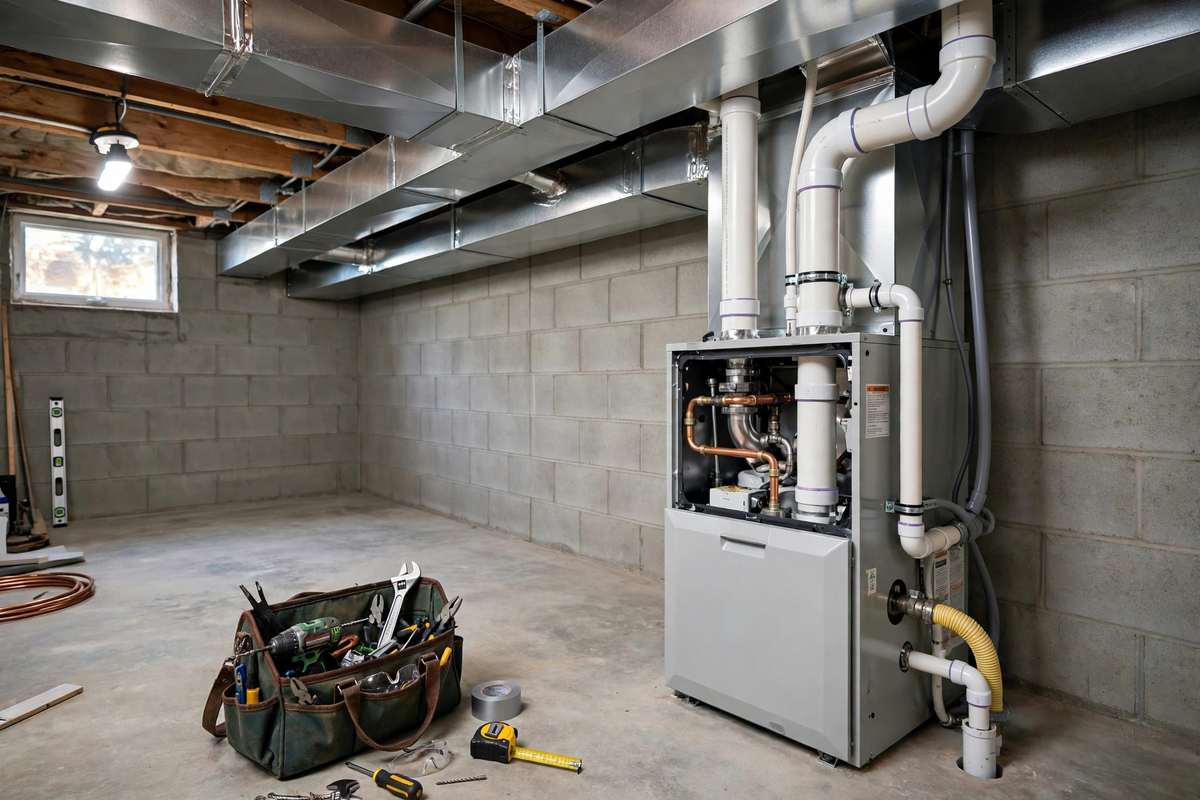
Tools & methods

Tools and methods we bring to a heating call

A heating call covers two kinds of system at once — air and water — so every link in the chain needs its own reading. These are the instruments that take them.

Combustion analyzer

It measures carbon monoxide, oxygen and flue temperature on a gas furnace or boiler, confirming the burner burns clean and the flue carries it out — the reading that separates a tuning fault from a safety fault.

Multimeter

It tests the electrical side of either system: igniter, flame sensor, blower motor and control board on a furnace; circulator pump, zone valves and aquastat on a boiler. An electrical fault is found on the meter, not by swapping parts and hoping.

Manifold gauge set

It checks gas pressure at the valve and confirms a furnace or boiler fires at its rated input at Denver altitude, where thin air changes how a burner behaves.

Leak detector

It checks every gas joint after a repair to confirm there is no leak, and doubles as the way a slow water leak is traced through a boiler system — at valves, unions, and the expansion tank.

Static pressure gauges

On a furnace home it measures airflow through the ductwork, so a restricted or leaking run is found rather than guessed at; on a boiler home the same reading habit carries over to balancing radiators room by room.

Infrared thermometer

It reads radiator and register temperatures room by room, so uneven heat is traced to its cause — a cold radiator at the end of a loop, or a register starved by a crushed duct.

Common situations

Heating trouble we see across Denver

No heat anywhere in the house

Situation

A Denver home has no heat at all on a cold night. The thermostat is set correctly, the furnace switch is on, and — in a boiler home — the radiators are cold to the touch.

What we check

The heat source is checked at the unit first, then the thermostat and controls. On a furnace that usually means a failed igniter or a tripped limit; on a boiler, a failed circulator or a pressure fault; on either, a thermostat that stopped calling for heat.

Heat in some rooms, not others

Situation

A two-storey Denver home heats the ground floor while the upstairs bedrooms stay cold, and in a boiler home one radiator never warms while the rest run hot.

What we check

Distribution is checked first, because uneven heat is usually a delivery problem: ductwork and airflow on the furnace side, trapped air and balancing on the boiler side, with the far rooms tested last.

A system that keeps tripping out

Situation

A furnace and a boiler in the same Denver winter both keep shutting themselves off, and each restart lasts a shorter time than the last.

What we check

The safety controls are tested and the cause they are protecting against is looked for — overheating from restricted airflow on a furnace, or pressure trouble on the water side of a boiler.

Problems we solve

Heating problems we fix in Denver every winter

No-heat calls mostly follow a few familiar patterns, and the pattern changes with the system: a furnace home and a boiler home fail in different places. These are the ones seen most across Denver.

Ask a pro →
01

No heat at all

The heat source is checked at the unit, then the thermostat and controls. A system that will not start is usually an ignition, control or power fault on a furnace, or a circulator, pressure or control fault on a boiler — and a meter finds which one it is.

↗
02

Heat in some rooms, not others

Uneven heat usually means distribution, and the two systems distribute differently: blocked ducts and leaking joints on the air side, trapped air in radiators and a pump that has stopped moving water on the water side. Rooms are checked one by one either way.

↗
03

System switching on and off

Short-cycling is usually airflow, pressure, or a safety control tripping — the filter and blower on a furnace home, the pressure and expansion tank on a boiler home — and the control is tested only after the cause behind it is found.

↗
04

Smell of gas or a carbon monoxide alarm

If you smell gas, leave the house and call 911 or the gas company from outside. If a carbon monoxide alarm sounds, leave and call 911. Do not stay inside to investigate — a heating fault that involves gas or carbon monoxide is never a wait-and-see call.

↗
Proof you can check

Heating system repair proof you can check

Denver heats with a mix — gas furnaces in most mid-century homes, boilers with radiators in the pre-war stock, and heat pumps in newer homes — so a heating repair visit here starts by identifying the system, not by assuming it.

Customer reviews

What Denver Customers Say

Eleven reviews on Google, all five stars — that is the record behind Lion Tech Home Services' 5.0-star rating.

“Martin was very prompt in responding to our requests and completing the work on a timely basis. His expertise is HVAC but he is very capable in all home maintenance areas. We have complete confidence in Martin's abilities and work and will call on him for any future projects we might have.”

JERRY SUNDBY — Google review

Good questions

Heating system repair questions Denver homeowners ask

(720) 806-7634 →

Most Denver homes heat with a gas furnace and ductwork, or a boiler with radiators — pre-war homes in Capitol Hill, Park Hill and Washington Park are often boiler homes. Unsure? Ring (720) 806-7634 and describe what you see in the basement; Lion Tech Home Services will help you work out which one it is.

Uneven heat usually means distribution, not the heat source. In a furnace home that is ductwork or airflow; in a boiler home it is air in the radiators or a balancing problem. Rooms are checked one by one to find where heat is being lost.

It turns on what failed and which system heats the house. A thermostat fault and a heat exchanger problem are very different jobs, so the diagnostic comes first and you hear what is wrong and what the repair involves before any work begins.

Lion Tech Home Services fixes furnaces, boilers and their controls across Denver, from Capitol Hill and Washington Park to Highland and Central Park. Ring (720) 806-7634 — the phone is answered around the clock.

Ready when you are

No heat in Denver? Call and talk through your system

Ring (720) 806-7634, describe what heats your house and what it is doing, and the next step gets talked through.

Call (720) 806-7634 →
Request an appointment

Contact Lion Tech Home Services

Lion Tech Home Services, Denver — call (720) 806-7634, open 24 hours.

Tap to call(720) 806-7634