Why Is My AC Not Cooling in Denver Summer?
AC blowing warm air in Denver? Learn the real causes — dirty coil, failed capacitor, frozen coil, low airflow — and how to fix an AC not cooling in summer.
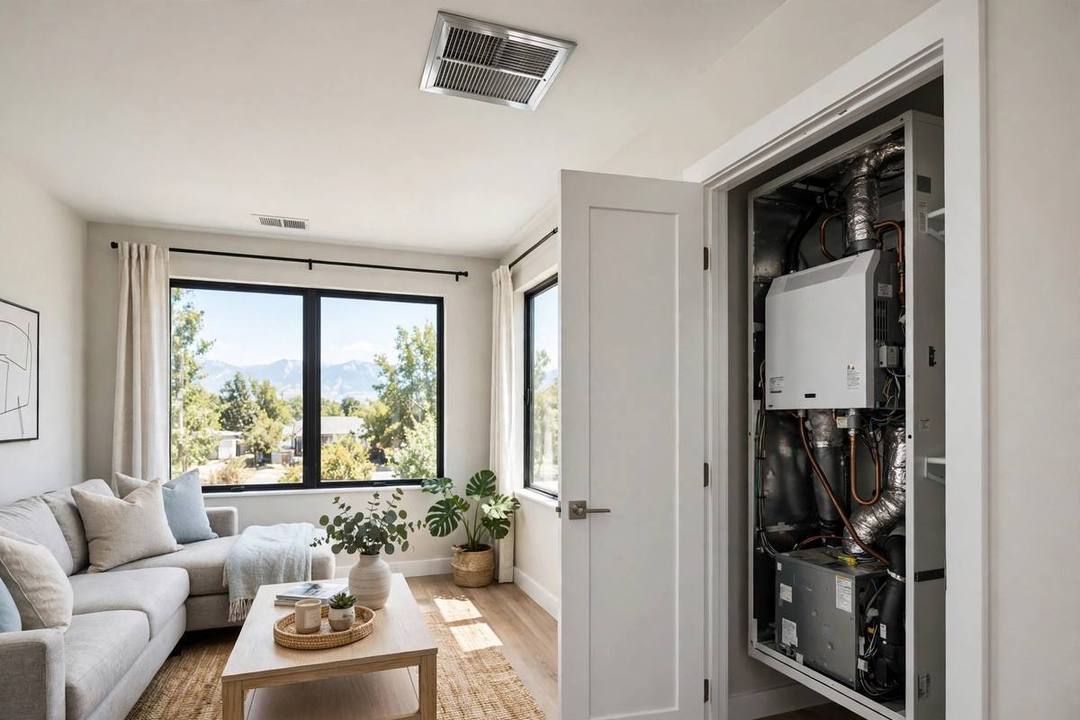
Your AC is not cooling in Denver summer because the system has lost its ability to move heat out of your house - most often from a refrigerant leak, a dirty condenser coil, a failed capacitor, or a frozen evaporator coil. Those four problems cause roughly 8 out of 10 warm-air calls we run between June and September. The rest of this post breaks down each cause, what a repair costs in 2026, what you can safely check yourself, and when it is time to call us.
Denver is a tough place to keep a house cool. At 5,280 feet, the air is thinner, so your condenser has less mass to transfer heat into. Add 95°F afternoons in July and August, and a system that was borderline in April will fall flat on its face by the second week of July. If you live in an older brick home in Capitol Hill or a 1970s ranch in Harvey Park, the equipment is working against building stock that was never designed for central air.
Why Denver summers are harder on air conditioners
Denver's altitude and dry air combine to make air conditioning harder here than in most U.S. cities. A condenser rated at 3 tons in Dallas delivers noticeably less capacity at 5,280 feet because there is simply less air density to reject heat into. That is not a sales pitch - it is physics, and it is why we size equipment differently here than a contractor in Kansas City would.
Three local factors show up on almost every diagnostic we run:
- Afternoon temperature swings. Denver routinely jumps from 60°F at 7 a.m. to 95°F by 3 p.m. Your system has to catch up fast, and undersized or aging equipment never does.
- Dust and cottonwood. The Front Range's spring cottonwood bloom packs condenser fins with fuzz. A clogged coil can cut capacity by 30% or more.
- Attic heat. Denver attics hit 140°F in July. Ducts running through them lose cooling before the air ever reaches your bedroom.
If your system was installed before 2015 and has never had a proper tune-up, this is likely the summer it starts to show. A scheduled air conditioning maintenance Denver CO visit in May catches most of these problems before the first 95°F day.
What causes AC to stop cooling in Denver
What causes AC to stop cooling in Denver is almost always one of six mechanical failures, and each one has a distinct signature you can hear, see, or feel at the thermostat. Here is how to tell them apart before a technician arrives.
1. Low refrigerant from a leak
Refrigerant does not get used up like gas in a car. If your system is low, it leaked - usually at a Schrader valve, a brazed joint, or the evaporator coil. Symptoms: the air from your vents is cool but not cold, the outdoor unit runs constantly, and you may see ice on the copper line entering the house. A proper repair includes finding the leak, not just topping off the charge. Topping off without a leak search means you will be calling someone again in 12 months.
2. Dirty condenser coil
The outdoor unit pulls air through finned coils. When those fins are packed with Denver dust and cottonwood, the compressor overheats and shuts down on a safety. You will notice the system runs for 10 minutes, quits, then tries again. A coil cleaning restores most of the lost capacity.
3. Failed capacitor
The run capacitor gives the compressor and fan motor their starting kick. When it bulges or fails, the outdoor fan may spin but the compressor hums and does nothing - or the whole unit sits silent. This is one of the most common warm-air calls we run in July.
4. Frozen evaporator coil
A frozen indoor coil blocks airflow completely. You will see frost on the refrigerant lines or a puddle under the air handler. Causes range from a dirty filter to low refrigerant to a blower motor on its way out. Turn the system off at the thermostat and let it thaw for 4-6 hours before you do anything else.
5. Duct leaks and attic heat gain
In Denver, ducts running through a 140°F attic can lose 20-30% of your cooling before the air reaches a register. If some rooms are cold and others are warm, this is usually the culprit. duct sealing Denver CO is one of the highest-return fixes we do on older homes.
6. Undersized or aging equipment
A 20-year-old 10 SEER unit that barely kept up in 2010 will not keep up now. If your system runs from 10 a.m. to 10 p.m. and never reaches the setpoint, it is either undersized, failing, or both. At that point, air conditioning installation Denver CO is usually cheaper than a third major repair in three years.
How do I fix my AC not cooling in Denver CO?
How do I fix my AC not cooling in Denver CO depends on whether the problem is airflow, refrigerant, or electrical - and you can narrow it down in about 15 minutes with a few checks that do not require a licence.
Start here, in this order:
- Check the filter. A clogged 1-inch filter is the number-one cause of frozen coils. Replace it if you cannot see light through it. Denver homes with pets need a new filter every 60-90 days.
- Check the breaker. Both the indoor air handler and the outdoor condenser have their own breakers. A tripped breaker means the unit is not running at all, not that it is running warm.
- Check the thermostat. Make sure it is set to COOL, the fan is on AUTO, and the setpoint is at least 3°F below room temperature. Sounds obvious - we still find this on 1 in 20 calls.
- Check the outdoor unit. Is the fan spinning? Is the coil packed with cottonwood? Is there ice on the copper line? Each answer points to a different repair.
- Check the vents. Closed or blocked registers in one room can starve the whole system and cause the coil to freeze.
If you have done all five and the air is still warm, the problem is refrigerant, a capacitor, or a compressor - all of which need a technician with gauges and a multimeter. If you are in a condo or older home in ductless mini-split repair Denver CO territory, the diagnostic path is different and usually faster.
Common mistakes Denver homeowners make with a warm AC
The most expensive mistake Denver homeowners make is running a warm AC for days hoping it will catch up. It will not. Here is what we see that turns a small repair into a big one.
- Running the system with a frozen coil. The compressor pulls liquid refrigerant and destroys itself. A simple thaw-and-clean becomes a compressor replacement.
- Adding refrigerant without finding the leak. You will pay for the same charge again next summer.
- Replacing the thermostat first. A new smart thermostat does nothing if the capacitor is dead. Diagnose before you buy.
- Ignoring a weak airflow room. One warm bedroom usually means a duct problem that is costing you 15% of your cooling everywhere else.
- Skipping spring maintenance. A tune-up in May prevents most of the July calls we run.
If you want to avoid all five, a AC tune-up Denver CO before Memorial Day is the cheapest insurance you can buy on a system you plan to keep.
When to call a professional
Call a professional the moment you see ice on the refrigerant lines, smell burning at the outdoor unit, hear the compressor humming without the fan spinning, or notice the breaker tripping more than once. Those four signs mean the system is damaging itself every minute it runs.
At Lion Tech Home Services, we run full diagnostics on Denver systems - refrigerant pressures, capacitor readings, static pressure, and duct temperature split - before we quote a repair. You get a straight answer on what is wrong and what it will take to fix it, and we do not sell you a new system when a capacitor will do the job. If you are on the fence about repairing or replacing, we will tell you which one makes sense for the age and condition of your equipment.
For homeowners across the metro, we also handle central air conditioning services Denver CO - from single-room airflow complaints to full system replacements - with scheduling during the summer rush.
Frequently Asked Questions
Why is my AC not cooling in Denver summer?
The most common cause is low refrigerant from a leak, followed by a dirty condenser coil, a failed capacitor, or a frozen evaporator coil. Denver's altitude and dust load make all four more likely here than in lower-elevation cities. A short diagnostic usually identifies the exact cause.
What causes AC to stop cooling in Denver?
Six failures account for nearly all warm-air calls: refrigerant leaks, clogged condenser coils, failed capacitors, frozen evaporator coils, duct leaks in hot attics, and aging equipment that has lost capacity. In Denver, cottonwood-blocked coils and attic duct losses are the two most under-diagnosed.
How do I fix my AC not cooling in Denver CO?
Check the filter, breaker, thermostat, outdoor unit, and vents first - those five checks solve about 20% of warm-air calls without a technician. If the air is still warm after that, the issue is refrigerant, electrical, or compressor-related and needs gauges and a multimeter.
Who do I call if my AC is not cooling in Denver?
Call a Denver HVAC company with summer availability. Lion Tech Home Services runs diagnostics across Denver, including Capitol Hill and Washington Park.
What affects the cost of an AC repair in Denver?
What a warm-air repair costs depends on the cause: a coil cleaning and a capacitor are the smaller jobs, a refrigerant leak repair is the middle of the range, and a compressor replacement is the biggest. A full system replacement depends on size and efficiency, and it is worth comparing against the age of the equipment.
Get help with Hvac in Denver
If your AC is blowing warm air and the house will not cool down, we can be at your door today. Lion Tech Home Services handles Denver AC repair, maintenance, and replacement with a clear written scope and no diagnostic games.
Call (720) 806-7634 and we will get your house cold again.