What Denver Homeowners Should Know Before Hiring an HVAC Pro
Denver homeowners: what to ask any HVAC contractor before you hire — permits, Manual J sizing at altitude, written scope, and red flags to avoid.
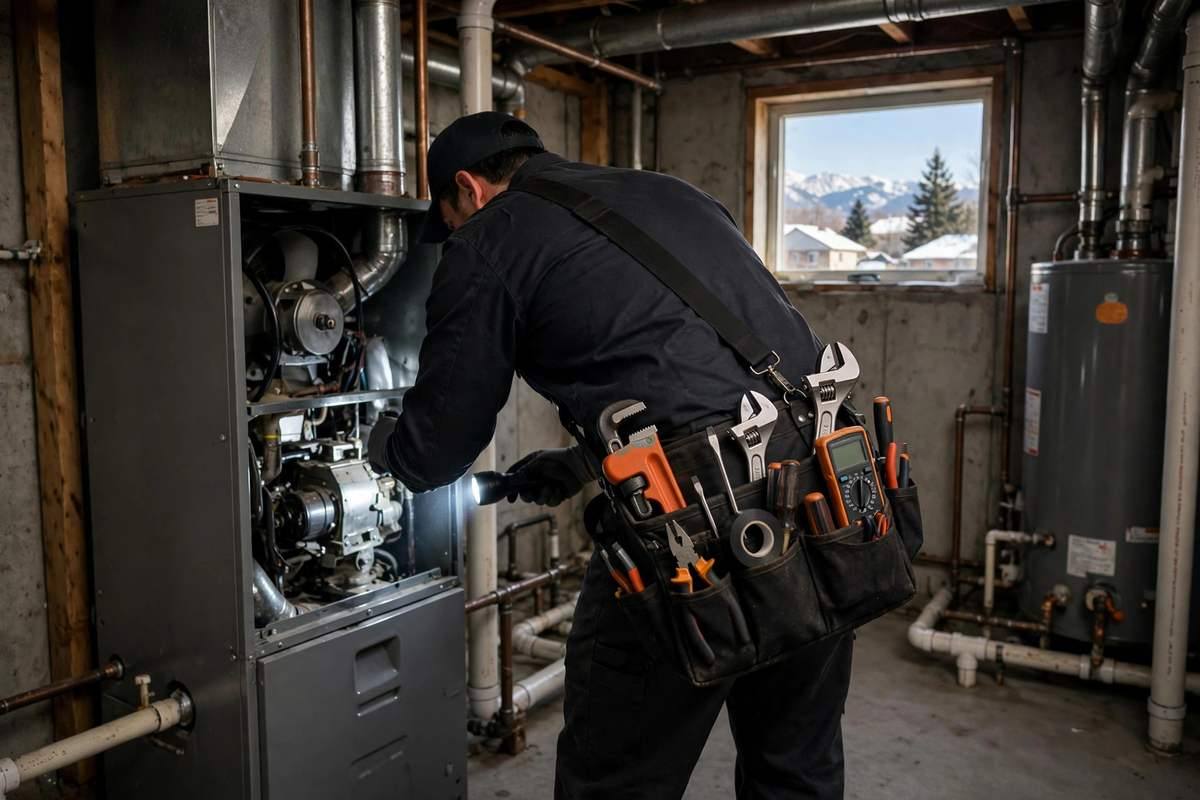
Hiring an HVAC pro in Denver is mostly about asking the right questions before anyone picks up a tool. The equipment matters, but the sizing, the ductwork, the permits, and the written scope matter more, and they are the things a homeowner can actually check. This guide covers what to ask any contractor, including us, and what to watch out for.
Denver is a furnace-first market at 5,280 feet, with roughly 6,000 heating degree days in climate zone 5B, and a housing stock whose median build year is 1975. More than half of Denver homes were built before 1980, and a third before 1960. That old stock is why the questions below are Denver-specific: a house built in 1910 does not take the same system as a house built in 2010.
What should I know before hiring an HVAC pro in Denver?
Know what the job is before you call. Is it a repair, a replacement, or a second opinion on a quote you already have? Note the system type, its age if you know it, and the symptom in plain words. A contractor that asks good questions about the house before talking about equipment is already telling you something about how it works.
Also know this: Colorado has no state HVAC licence. There is no state licence card to ask for, and anyone who shows you one is showing you something else. Denver licenses HVAC work locally, so the practical check is whether the contractor pulls the right permits for the job and can show you the paperwork. Ask about that instead of a state licence, and do not treat a trade certificate card as proof that a company holds it.
How do I verify an HVAC contractor in Denver?
- Ask about permits. Denver requires a mechanical permit for furnace, AC, and heat-pump replacement. Ask who pulls the permit, who handles the inspection, and whether the permit is named in the written scope.
- Ask how the system was sized. A Manual J load calculation done at altitude is the standard. At 5,280 feet, a furnace is derated roughly 4 percent per 1,000 feet, and air conditioning loses roughly 10 to 15 percent of its sea-level capacity, so a size based on square-footage rules of thumb is not a size at all.
- Ask for the scope in writing. Equipment model numbers, ductwork changes, venting, electrical work, thermostat, permit, and disposal of the old equipment. If it is not written down, it is not in the job.
- Ask for recent work on a house like yours. A contractor that has worked on pre-war Capitol Hill homes, or on large custom homes, should be able to talk about those jobs in detail.
- Ask what happens if the first fix does not hold. Get the follow-up arrangement in writing, not as a verbal promise.
Questions to ask an HVAC pro in Denver
- What permits does this job need, and who pulls them?
- Was the system sized with a Manual J calculation at altitude?
- What is in the written scope, and what would change it?
- What condition is my ductwork in, and was it assessed?
- What are my options, and what would you do if this were your house?
- What happens if the first repair does not fix it?
- What is covered after the job is done, and for how long, in writing?
For a repair, the most important question is the diagnosis: what failed, why it failed, and what the options are. A contractor that explains the diagnosis is giving you something you can act on. A contractor that only names a price is not.
How much should Denver homeowners pay an HVAC pro?
There is no single number, and any article that gives you one is guessing. What a job costs depends on the system type, the house, the ductwork, and the scope. The way to judge a quote is to compare scopes, not totals: two quotes are only comparable when they name the same equipment, the same ductwork, the same venting, and the same permit.
For scale on replacements, Oct/Nov 2026 market data for the Denver area puts a standard furnace replacement at roughly $3,800 to $8,650, a high-efficiency two-stage furnace at roughly $7,500 to $11,200, a cold-climate heat pump alone at roughly $6,000 to $14,000, and a central AC replacement at roughly $4,500 to $9,500. Those are market ranges, not Lion Tech Home Services prices, and they are the scale to use when you are weighing a big repair against a new system. For a repair, ask for the diagnosis and the options in writing before any work starts, and do not accept a quote that names a price with no scope behind it.
Denver-specific issues that change the job
- Altitude. Furnaces derate roughly 4 percent per 1,000 feet, and AC capacity drops roughly 10 to 15 percent. Sizing has to be done at altitude, and a unit set up for sea level will burn poorly here.
- Old stock. Many pre-war homes were built with coal-fired boilers or gravity furnaces and later converted to gas, and some still heat with radiators. Some have no ductwork at all, which makes a ductless mini-split the realistic cooling path.
- Ductwork. Denver homes built before 1980 often have ductwork that leaks a large share of heated or cooled air into the attic or crawlspace. Ask about duct sealing in Denver before you pay for a bigger system to push air through bad ducts.
- Dry air and smoke season. Winter indoor humidity often drops below 30 percent, and wildfire smoke runs June through September. Filtration and humidification are part of the comfort question, not an add-on.
- Freeze risk. Condensate lines, exterior heat-pump drains, and piping in unconditioned space all need freeze protection in a Denver winter.
What to watch out for when hiring HVAC help in Denver
- A replacement quote given over the phone, with no visit and no load calculation.
- Pressure to decide on the spot, or a price that is only good today.
- A quote with no equipment model numbers and no written scope.
- No mention of permits on a furnace, AC, or heat-pump replacement.
- A contractor that recommends replacement before testing the system.
- A company that asks you to look for a state HVAC licence, or that claims credentials it cannot show you. Colorado has no state HVAC licence.
When to call a professional
Call a professional when the system stops heating or cooling, when you smell gas, when water is leaking from the equipment, or when a breaker trips more than once. For a planned replacement, call before the system fails: a furnace that is fifteen years old and has needed two repairs in three winters is telling you something, and a planned replacement is a calmer job than an emergency one.
Lion Tech Home Services is happy to be judged on the questions in this guide. Ask us about permits, altitude sizing, and the written scope, and compare our answers with anyone else you call.
Frequently Asked Questions
What should I know before hiring an HVAC pro in Denver?
Know what the job is, ask how the system was sized, and get the scope in writing. Colorado has no state HVAC licence, so ask about Denver permits and the paperwork instead of a state licence card.
How do I verify an HVAC contractor in Denver?
Ask about permits, Manual J sizing at altitude, the written scope, and recent work on a house like yours. A contractor that pulls the right permits and can show you the paperwork is the one to trust.
What questions should I ask an HVAC company in Denver?
Ask what permits the job needs, how the system was sized, what is in the written scope, what condition your ductwork is in, and what happens if the first fix does not hold. Get the answers in writing.
Do I need a permit to replace a furnace in Denver?
Yes. Denver requires a mechanical permit for furnace, AC, and heat-pump replacement. Ask who pulls the permit and handles the inspection, and make sure the permit is named in the written scope.
What should a quote include?
Equipment model numbers, ductwork changes, venting, electrical work, thermostat, permit, and disposal of the old equipment. Two quotes are only comparable when the scopes match.
Get help with HVAC in Denver
If you are hiring for a repair or a replacement, call us and ask the questions in this guide. We will answer them straight.
Call Lion Tech Home Services at (720) 806-7634, any hour. Ask about permits, altitude sizing, and the written scope, and judge the answers against any other company called.